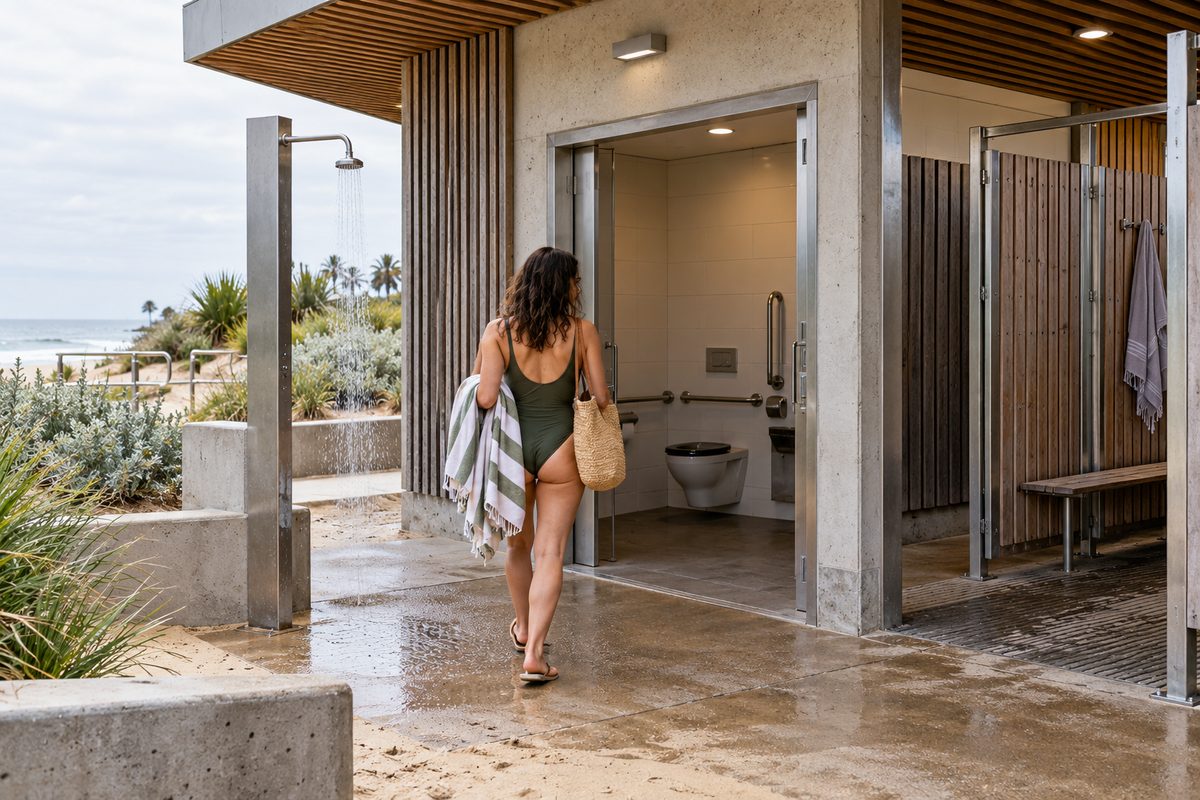
St Kilda Public Toilets and Changing Facilities
St Kilda has free public toilets spread along the foreshore and near its main shopping strips, but dedicated changing rooms are rare, so most beachgoers change inside a toilet cubicle or under a towel. The toilets are run by the City of Port Phillip. They are basic, unstaffed and built to take heavy use. If you plan around that, a beach day in St Kilda, Victoria gets much easier. If you expect a surf club style change room with lockers and hot showers, you will be disappointed.
This guide from St Kilda Almanac explains what the facilities are like, how to check them before you go, and what to do when you need something more than a basic cubicle. For more local guides, visit the St Kilda Almanac home page.
What is a foreshore toilet block actually like?
Expect a sturdy, plain building with a few cubicles and a hand basin. Many council blocks in Melbourne use stainless steel pans, basins and fittings. Stainless steel is chosen because it is hard to damage, quick to hose down and does not crack. The trade-off is comfort. The surfaces feel cold, some pans have no seat, and mirrors may be small or polished metal instead of glass.
Most blocks have no attendant. Cleaning runs on a council schedule, so a block can look very different at 9 am than at 4 pm on a hot Saturday. Toilet paper can run out. Floors near the beach get wet and sandy because people walk straight in from the water.
Here is what that means in practice:
- Carry a small pack of tissues or wipes.
- Bring hand sanitiser in case the soap dispenser is empty.
None of this is a sign of neglect. It is how high-traffic public toilets work in most Australian beach suburbs.
Where can you change after a swim?
For most people, the answer is a toilet cubicle. Public changing rooms with benches and hooks are uncommon on the St Kilda foreshore. Some toilet blocks have an outdoor tap or rinse shower nearby for washing sand off your feet, but hot showers for the public are not something you should count on.
A few options sit outside the public system:
- St Kilda Sea Baths. The Sea Baths building on the foreshore houses private businesses. Any change rooms inside belong to those businesses and are generally for paying customers or members. Check directly with the current operator before you assume access.
- Surf life saving club facilities. St Kilda has a long history of surf lifesaving, and its club rooms sit close to the beach. A Surf life saving club change room is for members and patrolling volunteers, not passers-by. If you join a club or a nipper program, you may get access. Otherwise, treat it as off limits.
The practical fix is simple. Wear your swimmers under your clothes on the way down. After your swim, use a change robe or a large towel with a drawstring. These let you change on the sand without needing a cubicle at all, which matters on busy days when there is a queue.
Why the cubicle queue builds so fast
A toilet block that serves the whole beach also becomes the change room for the whole beach. Every person who changes in a cubicle holds it for several minutes instead of one or two. On a warm weekend, that turns a short wait into a long one. People who need the toilet urgently, like young kids, are the ones who suffer most. If you can change on the sand, you free up a cubicle for someone who has no other choice.
How do you check a toilet before leaving home?
Use the National Public Toilet Map. It is a free Australian Government service at toiletmap.gov.au, and it lists public toilets right across the country, including those in the City of Port Phillip.
Search for St Kilda and you will see pins along the beach and around the shopping areas. Tap a pin to see details such as:
- Opening hours, if they are set
- Whether there is an accessible toilet
- Whether there is a baby change table
- Whether the toilet needs an MLAK key
- Whether there is a drinking fountain or shower nearby
The map relies on data supplied by councils and other owners. It can lag behind real changes, like a block closed for repairs or a new facility that just opened. Use it to plan, then check the City of Port Phillip website for any current closures in the area you are heading to.
Look at the pins near where you will sit
Most people search for "the nearest toilet" when they already need one. A better habit is to look before you choose your spot. Pick a patch of beach or lawn within a few minutes' walk of a toilet block. This is easy to do and it saves the most hassle, especially with small children.
What if you need an accessible toilet or adult change table?
Many St Kilda toilet blocks include an accessible cubicle. Under the Disability Discrimination Act and the building standards made under it, new or substantially upgraded public buildings must provide accessible facilities. Older blocks were built before those rules, so features vary from site to site. That is why checking each pin on the map matters.
Some accessible toilets in Australia are locked and open with an MLAK (Master Locksmiths Access Key). The key system keeps the cubicle clean and free for people who need it. If you have an MLAK, the National Public Toilet Map will show which toilets use it. If you do not have one, look for accessible cubicles that are left unlocked during opening hours.
A standard accessible toilet is not the same as a Changing Places facility. A Changing Places room has a height-adjustable adult change bench and a ceiling hoist. These are needed by people who cannot use a standard toilet even with a grab rail. They are much rarer. Check the official Changing Places website for the nearest one before your trip, since you may need to plan your day around its location.
What to check for an accessible visit
- Is there a clear, level path from parking or the tram stop to the toilet?
- Does the toilet need an MLAK key?
- Is the nearest Changing Places room close enough for your needs?
- What are the opening hours, especially in winter?
Can you rely on cafes along Acland Street and Fitzroy Street?
Not as a plan. Cafes, bars and restaurants on Acland Street and Fitzroy Street have toilets, but they are for customers. Many businesses will say no if you just walk in, and it is their right to do so. On busy days, staff often have no spare capacity to let the public through.
If you are buying a coffee or a meal anyway, use the toilet while you are there. That is a fair trade and it works. But for a full day out, public blocks are more reliable than hoping a business will help.
Shopping areas also have fewer public toilets than the beach. The foreshore is where council concentrates its blocks, because that is where most visitors spend time. If you are spending your day on the shopping strips, find the nearest public toilet on the map before you start.
Why do searches for Fitzroy keep sending people the wrong way?
Fitzroy Street, Melbourne runs through St Kilda. It is a different place from Fitzroy, Victoria, an inner-north suburb several kilometres away. Search engines and map apps sometimes mix the two up. If you type "Fitzroy toilets" you may get results for the wrong suburb entirely.
Always search using "St Kilda" or check that the pin sits near the beach, Port Phillip and the St Kilda Pier. If the map shows Brunswick Street or Gertrude Street, you are looking at the wrong Fitzroy.
Which spots make toilet access easier?
Areas that already draw a crowd tend to have facilities close by, because council places blocks where people gather. The stretch around St Kilda Pier, the main beach and Catani Gardens is the busiest part of the foreshore, and toilet blocks serve those areas.
Catani Gardens is popular for picnics and family gatherings. A toilet within walking distance makes a long afternoon on the lawn workable. Check the map for the exact block location before you set up, since the gardens cover a fair area.
Around the pier, toilets also serve people who walk the pier or come for the evening penguin viewing. Penguin viewing runs as free ticketed sessions. Check the official operator for current booking details, and use a toilet before you join the queue, since sessions can run a while.
A hypothetical example
Here is a hypothetical example, not a real visit. Picture a family with a toddler and a grandparent who uses a walking frame. They arrive by tram on a sunny Sunday. If they head straight for the sand, they may set up ten minutes' walk from the nearest block, on soft sand that is hard for the walking frame. A better plan is to check the National Public Toilet Map on the tram. They pick a grassy spot near an accessible toilet, on a firm path. The toddler can reach a toilet in a hurry, and the grandparent never has to cross the sand to get there.
How do crowds and seasons change things?
Hot weekends and major events put the most pressure on public toilets. During large events in St Kilda, organisers often bring in portable toilets, and some permanent blocks get very busy. Queues get long and cleaning cannot always keep up.
Winter is the opposite problem. Fewer people visit, and some blocks may have shorter hours. Check opening times on the map if you plan an early morning walk or an evening visit in the cooler months.
Tips that help on busy days:
- Go to the toilet before you leave the tram or car, not once you are settled.
- Walk a little further to a quieter block instead of waiting at the busiest one.
What about water and staying comfortable?
Look for a drinking fountain near the toilet blocks and along the foreshore paths. Many council fountains in the City of Port Phillip have a bottle refill spout. Bring a reusable bottle and fill it as you walk. Staying hydrated in the sun matters, and a fountain saves you buying water at beach prices.
Avoid using the hand basin in a toilet block to fill your bottle. Use a fountain instead. It is cleaner and built for the job.
What should you do if a toilet is broken or dirty?
Report it to the City of Port Phillip. Council takes reports through its website and customer service line. Give the location, such as the closest landmark or street, and describe the problem clearly. A blocked toilet, a broken lock or no water are all worth reporting. Council can only fix what it knows about, and a quick report helps the next person who comes along.
Your St Kilda toilet and changing plan
The single most useful habit is this: check the National Public Toilet Map before you choose where to sit, not after you need a toilet.
Do these things before your next visit:
- Open the National Public Toilet Map and find the blocks near your planned spot.
- Check for accessible cubicles, baby change tables or MLAK needs if they apply to your group.
- Look up the nearest Changing Places room if someone needs a hoist or adult change bench.
- Wear swimmers under your clothes and pack a change robe or large towel.
- Pack tissues, sanitiser and a refillable water bottle.
- Check the City of Port Phillip website for any closures on the day.
Five minutes of planning turns the toilet question from a worry into a non-issue. For more guides to getting around St Kilda, visit St Kilda Almanac.