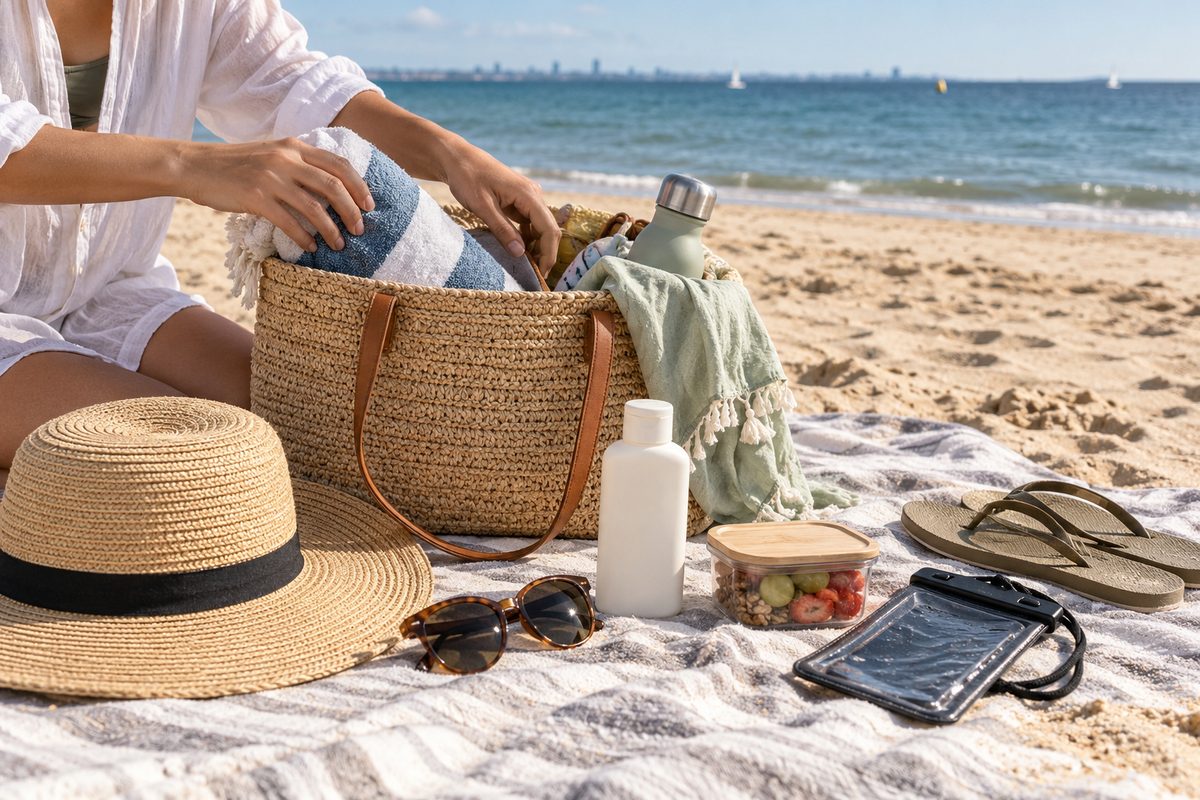
St Kilda Beach Day Packing Guide
Pack for wind and sun first, because a calm bay beach with little shade and a strong afternoon breeze catches out more visitors than anything else. Swimmers, towels and snacks are the easy part. A typical day at St Kilda, Victoria, starts warm and still, with strong sun overhead and almost no natural shade on the sand. By mid-afternoon a sea breeze often arrives off Port Phillip, sand starts to blow, and the temperature can drop fast. If you head to the pier after sunset, it gets colder again. A good bag covers all of those hours without getting too heavy to carry from the tram.
This guide from St Kilda Almanac focuses on what goes in the bag and why. For water safety, flags and swim timing, see our separate guide to swimming conditions on the St Kilda Almanac site.
Why does your arrival time change what you pack?
Your arrival time decides which conditions you face, so plan the bag around the clock, not the forecast high.
Melbourne summer weather moves in phases. Mornings at the beach are often the calmest part of the day. The water is flat, the wind is light, and the sun is already strong. Around midday to mid-afternoon, the land heats up faster than the bay. That pulls cooler air in off the water, and you get the sea breeze. On some days a cool change comes through and the temperature falls by ten degrees or more within an hour.
Here is a hypothetical example. Two friends arrive at 1 pm in shorts and singlets with one towel each. By 3 pm the breeze is up, sand is stinging their legs, and their towels keep lifting. They pack up early. A third friend arrived at 9 am, swam while the bay was flat, and left at noon with a light bag. Same beach, very different day.
The rule is simple:
- Morning visit: pack light and lean hard on sun protection.
- Afternoon visit: add a layer and something heavy to pin your towel down.
- Staying past sunset: bring a warm jacket, even on a hot day.
What protects you from the sun when shade is scarce?
Bring your own shade and treat sunscreen as one layer, not the whole plan.
The Ultraviolet index in Melbourne reaches 3 or higher for most of the year, and in summer it often climbs to 11 or more, rated extreme. The Cancer Council's SunSmart guidance says to use sun protection whenever the UV is 3 or above. That covers most beach days from spring through autumn, including mild, cloudy ones. UV is not heat. A cool, breezy day can still burn you, and the breeze hides the warning sign because you never feel hot.
The sand itself offers little shade. There are trees and grassy areas behind the beach, and Catani Gardens near the pier has big palms and lawn, but on a busy day those spots fill early. Pack for full exposure.
What sun gear actually works here?
- SPF 50+ broad spectrum sunscreen. Apply 20 minutes before you go out. Reapply every two hours and after swimming or towelling off.
- A broad-brim or legionnaire hat. Caps leave your ears and neck bare. Pick one with a chin strap or it will leave with the breeze.
- A long-sleeve rash vest. This is the item most people skip. It does more than sunscreen for your back and shoulders, and it never needs reapplying.
- Wraparound sunglasses. Sand and glare both bounce off the water.
- A beach tent or shade shelter with sand pockets. Umbrellas are a poor choice on a windy beach. A low tent that you weigh down with sand stays put far better.
Check the day's UV forecast on the free SunSmart app or the Bureau of Meteorology before you leave. It tells you the exact hours when protection is needed.
How do you pack for the afternoon wind?
Pack weight and layers. The wind is the single biggest reason beach days at St Kilda end early, and it is the one most packing lists ignore.
The sea breeze off the bay is often steady enough to lift a towel, flip a cheap umbrella and blow fine sand into food. It also cools you down quickly once you are wet. Water temperatures in the bay tend to sit in the high teens to around 20 degrees in summer, so a swim followed by a breeze can leave you shivering even on a warm day.
- Sand-resistant beach blanket or a towel with corner pockets. Fill the pockets with sand and it stays flat.
- Tent pegs or a few clips. Useful for shelters and for pinning a blanket edge.
- A light windproof jacket or hoodie. Throw it on after a swim and you can stay another hour.
- A dry bag or zip-lock bags. Keep your phone, keys and cards free of blown sand.
- Lidded containers for food. Open plates collect sand within minutes once the wind picks up.
Here is an angle most guides miss. When the breeze arrives, move rather than leave. Hypothetically, a family setting up near the water at noon can shift back toward the grass or to the lee side of a structure and recover the afternoon. A bag that packs down quickly makes that move easy.
How much water and food should you bring?
Bring at least one litre of water per adult for a few hours, plus a reusable Water bottle each so you can top up.
Wind and sun dry you out faster than you notice. A breezy day feels cool, so people drink less while still losing fluid. Children are especially quick to get dehydrated and slow to say so.
- Insulated Water bottle. Keeps water cold for hours on hot sand. There are drinking fountains around the foreshore for refills, but check they are working before relying on them.
- A small cooler bag with ice bricks. Fruit, sandwiches and drinks stay safe to eat for longer.
- Salty snacks. They help replace salt lost through sweat.
- A rubbish bag. Bins fill fast on busy days, and anything left on the sand can blow into the bay.
You do not need to carry every meal. The foreshore and nearby streets have cafes, kiosks and takeaway shops, and Acland Street is a short walk away. Our coffee guide covers where to find a good cup near the sand. The best approach is to carry water and snacks, then buy a proper meal nearby. That keeps the bag light.
What does the tram trip change about your bag?
If you come by tram, pack everything into one bag you can carry comfortably for ten minutes, because the walk to the sand is part of the trip.
Many visitors reach the beach by tram. Route 96 ends at the Acland Street tram stop, and from there it is a short walk across the Esplanade and down to the beach. Other routes stop along Fitzroy Street and the Esplanade. Driving is an option, and there is paid parking along Jacka Boulevard and nearby streets, but spaces go quickly on warm weekends and fees apply. Check the City of Port Phillip parking signs on the day.
The tram changes what makes sense to carry:
- Choose a backpack over a tote. Hands-free is easier on a crowded tram and on stairs.
- Skip the big esky. A soft cooler bag fits on your lap. A hard esky does not.
- Pick a folding shelter. A pop-up tent that folds flat travels better than an umbrella pole.
- Keep a myki card or phone payment ready in an outside pocket, away from wet swimmers.
- Pack a spare dry outfit or a towel to sit on. Riding home in damp, sandy clothes is the part of the day nobody enjoys.
Drivers can afford to bring more, such as chairs and a larger shade structure. Even so, the car park is not always close to your spot on the sand, so the one-trip rule still helps.
What should you pack if you plan to stay into the evening?
Add a warm layer, a torch-free mindset and a booking, because the evening plans at St Kilda depend on more than what is in your bag.
St Kilda Pier is a popular walk around sunset. The breakwater at the end of the pier is home to a colony of Little penguin birds, which come ashore after dark. Viewing now runs through free ticketed sessions. Check the official operator's website for current session times and how to book before you go, as times change with the season.
For an evening at the pier:
- A warm jacket. The pier sits out over Port Phillip and catches every bit of wind. It is often several degrees colder than the beach felt at lunch.
- Long pants or a change of clothes. Swimmers and shorts that felt fine at 2 pm feel very different at 9 pm.
- No flash photography. Bright lights and flashes disturb the penguins. Leave the torch in the bag and turn off your phone flash before you arrive.
- Your booking confirmation on your phone, with the phone charged. A small power bank is worth the space after a long day of photos and maps.
What about packing for kids?
Pack more water, more sun protection and fewer toys than you think you need.
Children burn faster than adults and rarely sit still long enough for sunscreen to dry. A rash vest and a hat with a neck flap do more work than repeated sunscreen. Add a small bucket and spade, and leave larger toys at home. They catch the wind and become one more thing to carry.
Luna Park, Melbourne sits on the Lower Esplanade, a short walk from the beach. If you plan to visit after the sand, pack shoes kids can walk in, since most rides and the paths around them are not barefoot friendly. Check Luna Park's website for opening days and ride height rules before you promise anything.
The St Kilda Adventure Playground is temporarily closed for upgrades as of late October 2026. Check the City of Port Phillip website for its current status before building a day around it.
What should you leave at home?
Leave behind anything that is valuable, fragile or likely to blow away.
- Glass containers. Broken glass on sand is a real hazard. Use plastic or metal.
- Expensive jewellery and watches. They are easy to lose in sand and water.
- Cheap beach umbrellas. They rarely survive the afternoon breeze and can injure people nearby when they lift.
- Alcohol, unless you have checked the rules. The City of Port Phillip has alcohol restrictions in parts of the foreshore. Check the council's current rules before you pack any.
- Single-use plastic wrap. It blows away the moment you open it.
Your St Kilda beach bag, step by step
Use this as a quick checklist the night before:
- Check the UV forecast and the wind forecast on the Bureau of Meteorology site. Note when the breeze is expected.
- Pack SPF 50+ sunscreen, a broad-brim hat, sunglasses and a long-sleeve rash vest for everyone.
- Fill one insulated Water bottle per person and pack a soft cooler with lidded food.
- Add a sand-pocket towel or blanket, plus a low beach tent if you plan to stay past midday.
- Pack a windproof layer and a dry change of clothes.
- Put phone, keys and cards in a dry bag or zip-lock bag.
- If staying for sunset, book a penguin viewing session at St Kilda Pier and add a warm jacket.
- Fit it all into one backpack you can carry from the Acland Street tram stop or the Jacka Boulevard car park.
For more on things to do around the foreshore, browse the guides at St Kilda Almanac.
The one thing to do: tonight, put a windproof layer and a long-sleeve rash vest in your beach bag. Those two items are what let you stay through the afternoon when most people pack up and leave.