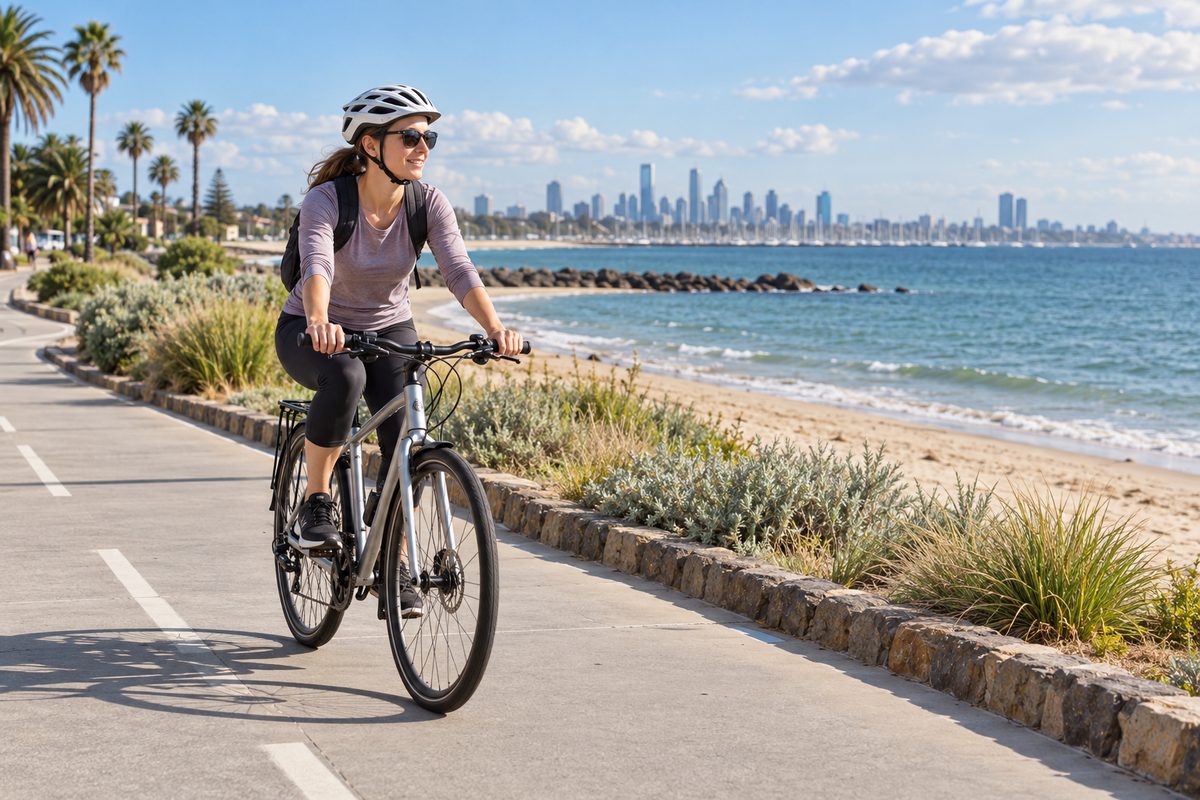
St Kilda Foreshore Cycling Guide
The best way to cycle the St Kilda foreshore is on the flat shared-use path that runs beside Port Phillip from Port Melbourne through St Kilda to Elwood, ridden early in the day at a relaxed pace. The path is easy, scenic and car-free, which makes it suit almost anyone on a bike. It is also busy. Walkers, prams, dogs, joggers and scooters all share it, so a good ride here depends on knowing where to slow down and when to switch to the road.
This guide from St Kilda Almanac covers the route section by section. It also covers the road option for faster riders, the links to the city and the lake, and the rules that keep everyone safe. For more on the suburb, start at the St Kilda Almanac home page.
Where does the foreshore ride start and finish?
Think of the ride as one long line along the bay with St Kilda in the middle. The path is part of the Bay Trail, which follows the coast of Port Phillip for many kilometres. For a St Kilda ride, most people use the stretch between Port Melbourne in the north and Elwood in the south. That is roughly 7 kilometres one way, and almost all of it is flat.
You can ride it in either direction. Below, it is broken into the three sections you will actually feel on the bike.
Port Melbourne to St Kilda
This section starts near Station Pier in Port Melbourne and heads south past Beacon Cove, the Middle Park beaches and the kiosks along the sand. It is the widest and calmest part of the ride. The path sits between the beach and the grass, with the bay on one side and parkland on the other.
The distance from Station Pier to St Kilda Pier is about 4 kilometres. At an easy pace that takes 15 to 20 minutes. Expect beach crossings where people walk from car parks to the sand. Those crossings are where most near misses happen, so ease off as you pass them.
The St Kilda core
The busiest stretch runs from St Kilda Pier past the St Kilda Sea Baths and on towards the Palais Theatre and Luna Park. This is the heart of St Kilda, Victoria, and on a sunny weekend it is crowded. Families, tourists and people heading to cafes spill across the path.
Treat this section as a slow roll, not a training run. Walking pace is often the only safe speed near the Sea Baths and the pier entrance. If you want to stop, this is the place. The pier, the beach and the Esplanade all sit within a few hundred metres.
St Kilda to Elwood
South of the Palais Theatre the path quietens. It passes the St Kilda Marina, the botanical edge of Moran Reserve and the grassy foreshore before reaching Elwood, Victoria, near Point Ormond. That run is about 3 kilometres.
This section is the favourite for many riders because the crowds thin out and the views open up. You can keep going past Elwood towards Brighton if you want a longer day. If you plan to walk this same stretch instead, it is covered in our separate St Kilda to Elwood foreshore walk guide on the St Kilda Almanac site.
Path or road: which one suits your ride?
Use the shared path for a relaxed ride. Use the road for speed. The two serve different riders, and mixing them up causes most of the friction on the foreshore.
The shared-use path is built for everyone. It has no cars, it is flat and it passes the best views. The trade-off is that you must give way to people on foot. A hypothetical example shows why this matters. Picture a rider doing 30 km/h on a Sunday morning near the Sea Baths. A toddler steps off the grass. Even a quick stop at that speed is a risk for both of them. The same rider on the road would never face that problem.
Beach Road, Melbourne is the road option. South of St Kilda it becomes one of the most popular road cycling routes in the state, running down the bay towards Brighton, Sandringham and beyond. It has an on-road bike lane for much of its length, and groups of road cyclists use it at speed, especially early on weekend mornings. Near St Kilda, the main roads such as Marine Parade and the Esplanade carry traffic and parked cars, so be alert for opening doors.
A simple rule works well:
- Riding under about 20 km/h, with kids, or stopping often? Take the shared path.
- Riding fast, in a group or training? Take the road and its bike lane.
How do you link the foreshore to the city and the lake?
The foreshore path connects to two useful routes, so you do not need to drive to the start.
The Sandridge Trail from the city
The Sandridge Trail runs from near Southbank to Port Melbourne, following the old Sandridge railway line that is now the route 109 tram corridor. It is a separated path for much of the way and drops you close to Station Pier. From there you join the foreshore and head south to St Kilda. This is the easiest car-free link from the city to the bay.
Fitzroy Street to Albert Park and Lake
Fitzroy Street, Melbourne runs from the St Kilda foreshore up towards St Kilda Junction. It has a bike lane, and it links to the paths around Albert Park and Lake. The loop around the lake is about 5 kilometres and is popular with walkers and runners as well as riders.
Linking the two makes a strong loop. You can ride the lake, roll down Fitzroy Street to the beach, follow the foreshore north to Port Melbourne, then head back inland. The whole loop is mostly flat and keeps you off the busiest main roads.
What rules apply on the shared path?
On a shared path in Victoria, cyclists must keep left and give way to pedestrians. That one rule explains most of what good riding here looks like. The path is managed by the City of Port Phillip, which installs signs and markings along the foreshore to remind users how to share it.
The basics are clear:
- Wear a helmet. Bicycle helmets are compulsory in Victoria, on paths and roads alike.
- Keep left. Pass on the right, and only when there is room.
- Give way to people on foot. Pedestrians have priority on a shared path.
- Use your bell early. Ring it well before you reach someone, then pass slowly. A bell right behind a walker startles them.
- Use lights at night. A white front light and a red rear light are required when it is dark.
What most guides miss is how the rules feel in practice. The law sets the minimum. The foreshore also has unwritten habits. Riders slow right down near the pier and the Sea Baths. They walk their bikes when the crowd is thick. They pull fully off the path before stopping to take photos. Following these habits makes the ride calmer for everyone, including you.
Check the current council signage on the day. The City of Port Phillip updates path layouts and works zones along the foreshore, and some sections may close for upgrades.
When is the path quiet enough to ride properly?
Ride before 9am, or on a weekday, for the clearest path. Early mornings bring joggers and dog walkers but far fewer families and visitors. By late morning on a warm weekend, the St Kilda core can slow to walking pace.
Weather changes the ride more than most people expect:
- Wind. The bay is exposed. Afternoon sea breezes can turn an easy ride into a headwind slog. Check the forecast and plan to ride into the wind first, so it helps you home.
- Heat. There is little shade on parts of the path. On hot days, go early and carry water.
- Events. Big days in St Kilda, such as summer festivals and fun runs, fill the foreshore. Check the council events calendar before you go.
Sunset rides are popular too, and the light over Port Phillip is worth it. Bring lights, because the ride home will be in the dark.
What do riders most often get wrong?
The most common mistake is treating the shared path like a road. A close second is misjudging how long the ride takes in the busy middle section. A 7 kilometre ride can take twice as long on a crowded Saturday because of all the slowing down.
Other common errors include:
- Riding onto St Kilda Pier. The pier is a walking space with heavy foot traffic. Lock your bike at the foreshore and walk out. If you hope to see the penguins, note that viewing runs as free ticketed sessions. Check the official operator for current times and bookings.
- Searching the wrong place. Search results for Marine Parade, Napier often appear when people look up St Kilda's Marine Parade. Napier's seafront is in New Zealand. Make sure any map or route you download is for St Kilda.
- Forgetting the return trip. The ride out with a tailwind feels easy. The ride home into the same wind does not. Save energy for the way back.
- Leaving bikes unlocked. The foreshore is busy, and bikes left leaning on a fence are easy targets. Always lock to a fixed rail or bike hoop.
Where can you stop, lock up and refuel?
The St Kilda core is the best place to take a break. Bike hoops sit along the foreshore near the pier, the Esplanade and the main beach kiosks. Lock up, then walk to cafes on the Esplanade, Acland Street or Fitzroy Street.
Public toilets and drinking fountains are spaced along the path, including near the main beaches in Middle Park, St Kilda and Elwood. If you ride with children, building the stop around a play space and a snack makes the ride far easier. Our guide to St Kilda family friendly restaurants on the St Kilda Almanac site covers where to eat with kids. If you planned to stop at St Kilda Adventure Playground, note it was temporarily closed for upgrades when this guide was checked. Confirm its status with the City of Port Phillip before you go.
Sample rides for different riders
These routes use only the paths and roads covered above. Times are estimates at an easy pace.
- Family pedal (about 6 km return, 40 minutes). St Kilda Pier to Elwood and back on the shared path. Flat, short and full of stopping points.
- Bay classic (about 14 km return, 1 hour). Port Melbourne to Elwood and back along the foreshore. The full St Kilda stretch with the busy core in the middle.
- City to bay (about 20 km loop). Ride the Sandridge Trail to Port Melbourne, follow the foreshore to St Kilda, climb Fitzroy Street, lap Albert Park and Lake, then head back towards the city.
- Road training (distance of your choice). Start at St Kilda and head south on Beach Road, Melbourne using the bike lane. Turn around when you reach your target distance.
Your plan for the ride
Pick your ride by speed first: shared path for relaxed riding, Beach Road for fast riding. Everything else follows from that choice.
Before you go:
- Choose a route from the sample rides above and check the wind forecast.
- Plan to start before 9am if you want a clear path through the St Kilda core.
- Pack a helmet, lights, water and a lock.
- Check City of Port Phillip notices for path works, events and playground closures.
- If you want to see the penguins, book a free session through the official operator first.
On the day, keep left, ring your bell early and slow right down near the pier and the Sea Baths. Do that, and the St Kilda foreshore is one of the easiest and most rewarding rides in Melbourne.