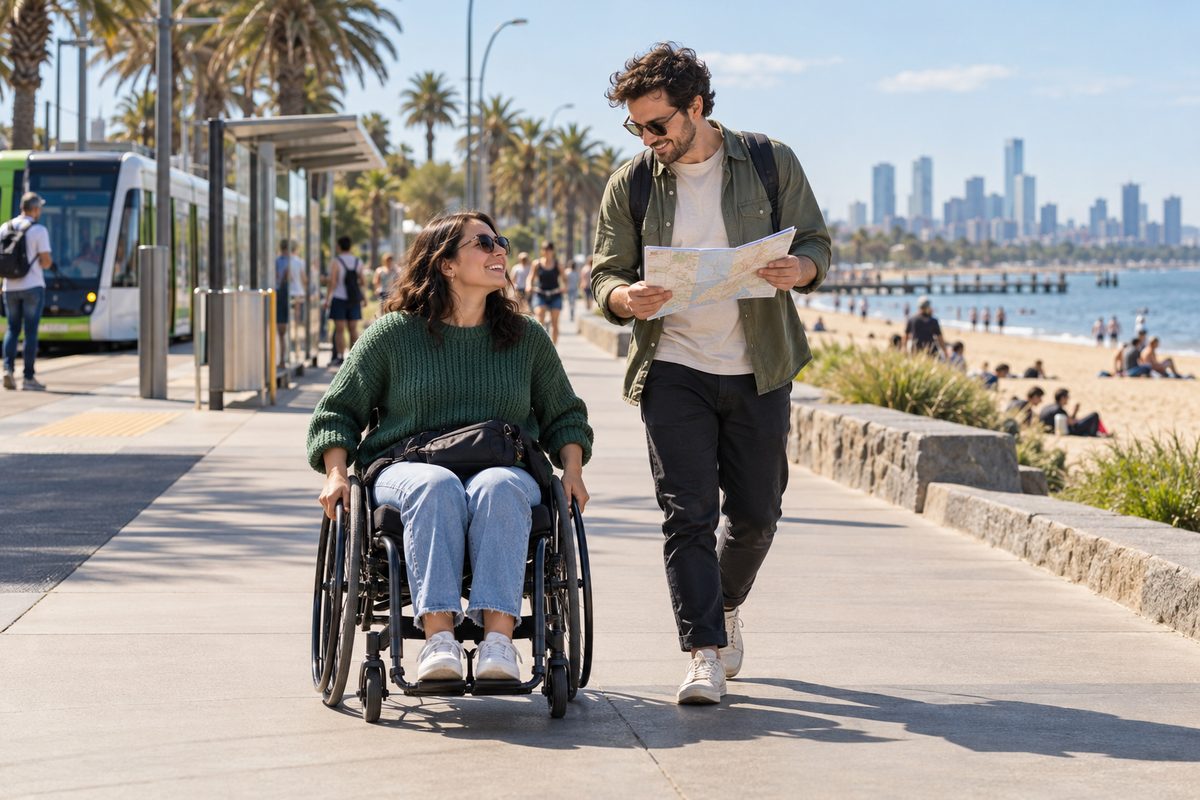
St Kilda Accessible Day Out Planning
The best accessible day out in St Kilda is built around one flat zone, a confirmed accessible toilet, and a step-free way home, all checked on the day you go. Most trips go wrong because people plan a list of places instead of a route. St Kilda is compact, but the ground changes fast. The foreshore is mostly flat. The streets behind it climb, and some old buildings have steps at the door. If you plan by zone and confirm a few facts before you leave, you can spend your energy on the day instead of on detours.
This guide from St Kilda Almanac covers how to plan, not just where to go. For broader local guides, start at the St Kilda Almanac home page.
Why does a route matter more than a wishlist?
A route matters because distance and gradient drain energy faster than people expect. A wishlist might say: pier, gardens, theatre, cake shop. On a map these look close. In practice, the St Kilda Botanical Gardens sit uphill and inland from the beach, while the pier sits out on the water. Linking them on foot or by wheelchair means a long push or walk with a rise in the middle.
Here is a hypothetical example. A family with a grandparent who uses a walker plans to see the pier in the morning, the gardens at lunch, and a show at night. By 2pm the grandparent is worn out, and the family skips the show they paid for. If the same family had picked the foreshore for the day and saved the gardens for another visit, the evening would have worked.
The fix is simple. Choose one anchor area per visit. Add a second only if it sits on the same level or links by an accessible tram.
The three zones that make planning easier
- The foreshore zone: St Kilda Pier, the beach promenade, the Upper Esplanade and the area around Luna Park, Melbourne. Mostly flat, with long open paths and sea breezes.
- The village zone: Acland Street and Fitzroy Street. Shops, cafes and tram stops, with some kerbs, outdoor dining clutter and busy footpaths.
- The gardens zone: St Kilda Botanical Gardens off Blessington Street. Quiet, shaded and calm, but a short climb from the beach.
The foreshore and village zones link well. The gardens zone works best as its own trip or with a ride in between.
What should you check before you leave home?
Check four things on the morning of your trip: closures, toilets, transport and weather. Information online can be months old, and St Kilda has had several upgrades in recent years. Research checked on 23 October 2026 found the St Kilda Adventure Playground temporarily closed for upgrades, which shows how often things change. Always confirm current status with the City of Port Phillip before you count on any council facility.
Closures and works
The City of Port Phillip runs most of the parks, foreshore paths and public toilets in St Kilda, Victoria. Its website lists works, closures and event road changes. Big events on the foreshore can close paths or move crowds onto narrow routes. A quiet Tuesday and a festival Sunday feel like two different suburbs.
Accessible toilet locations
Know where your nearest accessible toilet is before you need it. This one step removes most of the stress from a day out. Use the National Public Toilet Map, which lists features such as accessible stalls, baby change and opening hours. Some accessible toilets in Australia use the MLAK key system. If you have an MLAK key, bring it. If you need a hoist and an adult change table, search the Changing Places map separately, because a standard accessible toilet does not include them.
A smart habit is to mark two toilets on your route, not one. If the first is closed for cleaning or out of order, you already know the backup.
Weather on Melbourne bayside
Melbourne bayside weather turns quickly. Wind off the bay can make the pier feel cold even on a sunny day, and there is little shelter at the far end. Heat matters too, since the promenade has long stretches without shade. For people who struggle with temperature, plan the exposed part of the day for the mildest hours and keep shaded spots, like the gardens or a cafe on Acland Street, for the hottest stretch.
How do you get to St Kilda without a hard trip?
Trams are the most practical way in for most visitors, but not every tram is step free. Yarra Trams runs a mixed fleet. Low-floor trams with level access stop at platform stops, while older high-floor trams have steps. The difference matters a lot if you use a wheelchair, scooter or pram.
Trams from the city cross the Yarra River heading south and reach St Kilda along several routes. Route 96 runs to the Acland Street end of St Kilda and uses many low-floor trams on a light rail section with raised platforms. Route 16 travels along the beach edge. Use the PTV journey planner or app, which can show whether a service is low floor. Check this before you leave, and again at the stop if the app allows live updates.
Plan the trip home first
Most people plan the arrival and forget the return. At the end of the day you are tired, and the last thing you want is a high-floor tram and a long wait. Look up your return tram before you leave home. Note the stop, the route and roughly when low-floor services run. If you drive, check the council map for accessible parking bays near your anchor zone, since the bays near the beach fill early on warm weekends.
Which places suit an accessible visit, and what should you know about each?
Each main spot has a different access profile. Knowing it ahead of time helps you match places to the person, not the other way round.
St Kilda Pier
The pier is one of the flattest, widest walks in the area, which makes it a strong pick for wheelchair users and people who need even ground. The pier has been rebuilt by Parks Victoria, so check its website for current opening hours and any section still closed. The main limit is weather. There is little cover, and wind can be strong.
The pier is also where the little penguins live, near the breakwater. Penguin viewing runs as free ticketed sessions. Book through the official operator listed by Parks Victoria, and ask about access for your needs when you book. Sessions run around dusk, so plan for cooler air and lower light on the return.
Luna Park, Melbourne
Entry to the grounds is free, and the paths are mostly level, so you can enjoy the sights and sounds without buying ride tickets. Rides are a different matter. Many have height, mobility or health rules, and some require a transfer from a wheelchair. Check the park's accessibility page and ride rules before you buy a pass, since buying an unlimited ride pass for someone who can ride only a few rides wastes money. Ask about any companion card or carer policy when you contact them.
For a full planning breakdown of rides and tickets, see the Luna Park guide on St Kilda Almanac.
Palais Theatre
The Palais Theatre sits on the foreshore next to Luna Park, so it pairs well with a flat afternoon on the Esplanade. It is a historic venue, which means access depends on where you sit. Book accessible or wheelchair seating directly through the venue or its official ticketing partner, and ask about step-free entry, lift access and the nearest accessible toilet inside. Do this when you book, not on the night, because accessible seats are limited.
Esplanade Market
The Esplanade Market runs on Sundays along the Upper Esplanade. The stalls line a wide path with sea views, which makes it easier to browse than a crowded indoor market. The tricky part is crowds. Late morning to early afternoon is busiest. If crowds or noise are hard for your group, arrive soon after opening, when the path is clearer and stall holders have time to talk.
Acland Street
Acland Street is known for its cake shops and cafes. The street was redesigned with a pedestrian section near the tram terminus, which helps. Still, footpaths get busy, outdoor tables narrow the space, and some older shopfronts have a step at the door. Call ahead if you plan to eat at a specific cafe and ask about entry, table space and toilets. Many small venues do not have an accessible toilet on site, so pair your meal with a known public one nearby.
St Kilda Botanical Gardens
The gardens are the calmest place in the suburb and a good choice for people who find crowds or noise draining. As a botanical garden, it has wide paths, lawns, a rose garden and a conservatory, with plenty of benches and shade. It is a short distance from the beach, but the route rises. For many visitors, it works best as its own short outing or with a tram or car ride to the Blessington Street side. Check the council page for current toilet locations inside the gardens before you go.
How do you plan energy, not just places?
Plan rest stops the same way you plan sights. This is the step most guides skip. Accessible planning often stops at ramps and toilets, but fatigue, pain and sensory overload end more days out than steps do.
Build a rest stop every 30 to 45 minutes
Look for benches, shaded lawns or a cafe at regular gaps along your route. The promenade between the pier and Luna Park has seating, but long gaps exist in places. Bring a folding stool or seat cane if the person you are with needs to sit often.
Plan for sensory load
Luna Park has loud music, screams from rides and flashing lights. The market and Acland Street get crowded. For autistic visitors or anyone sensitive to noise, pack ear defenders or headphones and pick a quiet retreat in advance. The gardens and the far end of the pier on a calm day are two of the quietest spots close by.
Keep one optional item at the end
Put your least important stop last. If energy holds up, you add it. If not, you skip it with no loss. This keeps the day ending on a good note instead of a rushed one.
What do most accessible guides get wrong about St Kilda?
Most guides treat access as a yes or no label. A place is either accessible or not. Real access depends on the person, the day and the time.
A flat pier is fine for a wheelchair user on a still morning, but hard work into a strong headwind. A theatre with lifts still needs a seat booked in the right section. A toilet marked accessible on a map may be locked after hours or need an MLAK key. Labels help, but they do not replace a quick call or a check of the official source.
The other common gap is the end of the day. Guides describe how to arrive and what to see, then stop. The return trip, when everyone is tired and the light is fading, is where many plans fall apart. Treat the trip home as part of the plan.
What does a realistic accessible day look like?
Here is a hypothetical plan for a Sunday, built around the foreshore zone. Adjust the times to suit your group.
- Arrive mid-morning on a low-floor route 96 tram to the Acland Street end, after checking the PTV app.
- Visit the Esplanade Market early, before the busy period.
- Use a known public accessible toilet near the foreshore, with a second one marked as backup.
- Have lunch at a cafe you have called ahead to confirm step-free entry.
- Take a slow walk or roll along St Kilda Pier while the afternoon is still mild.
- Rest on a shaded bench, then wander through Luna Park grounds if energy allows.
- Head home on a low-floor tram you looked up before leaving.
Save the St Kilda Botanical Gardens and an evening show at the Palais Theatre for a second visit. Splitting the suburb across two trips gives a better day than squeezing it into one.
Your next step
Before your next trip, open three tabs: the City of Port Phillip closures page, the National Public Toilet Map, and the PTV journey planner. Pick one zone, mark two accessible toilets on your route, and look up your low-floor tram home. That ten minutes of checking is what turns a St Kilda day out into one that works for everyone in your group.