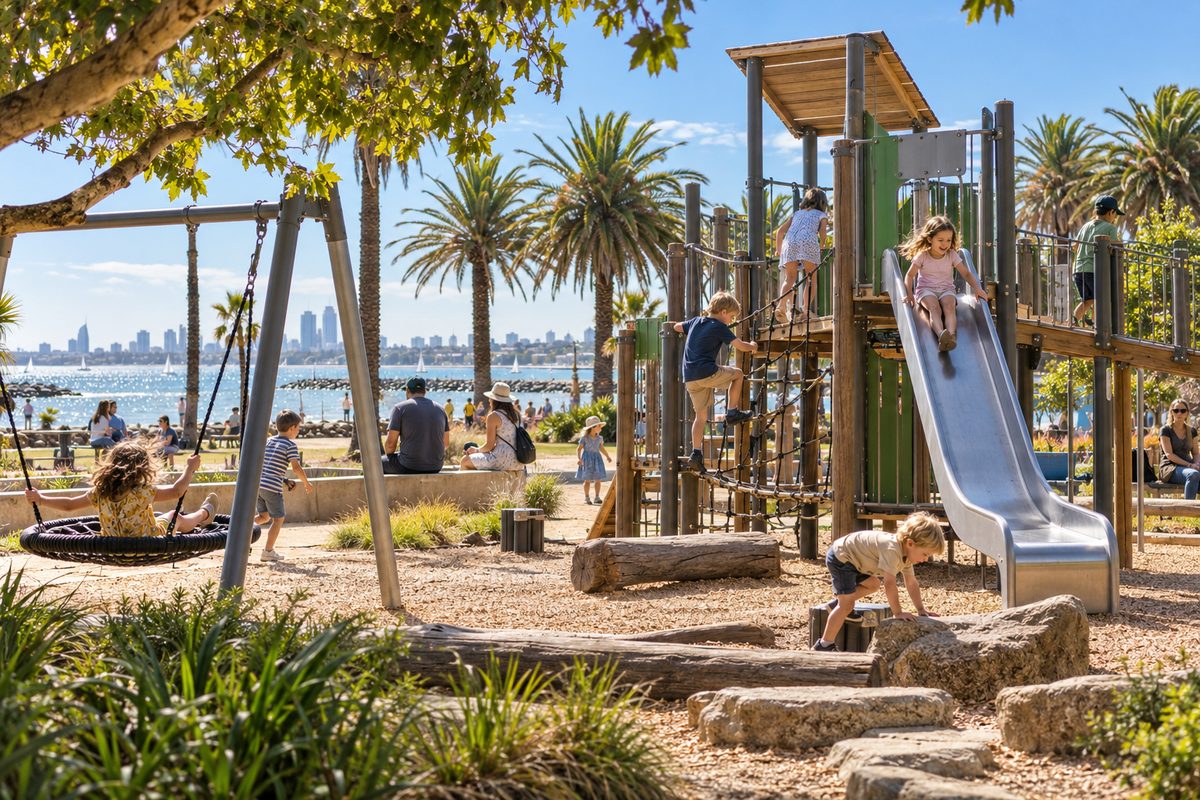
St Kilda Playgrounds Guide
The best St Kilda playground for your family depends on your child's age and the weather, so match the play space to both before you leave home. St Kilda has three broad kinds of play space: a staffed adventure playground, garden play areas inland, and open spaces near the foreshore. Each one suits a different kind of day. This guide from St Kilda Almanac helps you pick the right one, check what is actually open, and plan around the things that make or break an outing with kids.
One thing first. The St Kilda Adventure Playground is temporarily closed for upgrades as of our research check on 23 October 2026. Check its current status with the City of Port Phillip before you plan a day around it.
Which St Kilda are you searching for?
Make sure you are reading about the right suburb. This guide covers St Kilda, Victoria, the bayside suburb a few kilometres south of the Melbourne CBD. There is also St Kilda, South Australia, a small coastal town north of Adelaide. It has its own well known adventure playground near the mangroves, and search results often mix the two up.
If a listing mentions Adelaide, the City of Salisbury or a long drive along Port Wakefield Road, it is the South Australian one. If it mentions trams, Luna Park or the City of Port Phillip, it is the Melbourne suburb.
A second mix-up catches visitors too. Fitzroy Street, Melbourne runs through St Kilda. It is not in Fitzroy, Victoria, which is a separate inner north suburb on the other side of the city. If a map app sends you north of the river, you have typed the wrong Fitzroy.
What kinds of playgrounds does St Kilda have?
St Kilda's play spaces fall into three types. Knowing the type tells you more than a star rating does.
The staffed adventure playground
An adventure playground is different from a standard council playground. Kids build, climb and explore on structures that are often hand made and change over time. The St Kilda Adventure Playground is run by the City of Port Phillip and has staff on site during opening hours. That supervision is the main draw. Children can take on bigger physical challenges than a fixed play set allows, with trained adults nearby.
Adventure playgrounds work best for primary school aged kids who are bored by slides and swings. Toddlers can enjoy them, but much of the equipment is built for older, more confident climbers.
Because the St Kilda site is closed for upgrades right now, treat it as a future option. When it reopens, check the council website for opening days and hours. Staffed sites run set sessions and are not open around the clock like a normal park.
Garden play spaces
The St Kilda Botanical Gardens sit inland from the beach, off Blessington Street. As a botanical garden, the main purpose is plants: rose beds, a conservatory, big old trees and a lake. That setting changes how a playground visit feels. You get shade, lawns for running and quieter paths for prams.
Garden play suits younger children and families who want a slower pace. A parent can sit on a bench while a toddler explores, then walk to the lake to look at ducks. Older kids who want speed and height may run out of things to do faster.
Foreshore and open spaces
The foreshore area near Luna Park, Melbourne and the Esplanade has open lawns, the beach and plenty to look at. Play here is less about equipment and more about space: sand, grass and long paths for scooters.
These spaces are busiest on warm weekends and during events. They also take the full force of the wind off Port Phillip, which matters more than most parents expect.
How do you pick the right play space for your child's age?
Match the space to what your child can do now, not what you hope they will do.
- Under 3: Go for enclosed or quiet spaces with soft ground and nearby seating. The St Kilda Botanical Gardens suit this age well because the paths are calm and there are fewer bikes and scooters.
- 3 to 5: Look for low climbing frames, swings and room to run. Garden play spaces and smaller local parks work well. Keep an eye on how close the play area sits to roads or the water.
- 6 to 12: This is the adventure playground age. When the St Kilda Adventure Playground reopens, it will be the strongest option. Until then, combine open lawn space with scooters, a ball or a kite on the foreshore.
Here is a hypothetical example. A family arrives with a two year old and an eight year old. If they choose only the foreshore, the toddler gets overwhelmed by crowds and wind. If they choose only a small toddler park, the eight year old is bored in ten minutes. A better plan is a garden play space in the morning while energy is fresh, then the open foreshore after lunch so the older child can burn off steam.
What facilities should you check before you go?
Facilities decide how long you can stay. A great play space with no toilet nearby often ends in an early, rushed trip home.
Public toilet access
Check where the nearest public toilet is before you settle in. For toilet training children, a two minute walk is fine. A ten minute walk is not. The City of Port Phillip lists public toilet locations, and the foreshore and larger parks are generally better served than small pocket parks. Toilets in parks sometimes close for cleaning or repairs, so have a backup in mind, such as a cafe on Acland Street where you buy something.
Drinking fountain and water
A drinking fountain saves you carrying litres of water. Do not rely on one being there or working. Pack a full bottle for each child anyway, especially in summer. Kids playing hard in the sun dehydrate faster than adults, and they rarely say they are thirsty until they are cranky.
Picnic table and seating
A picnic table turns a playground stop into a lunch break. On busy weekends, tables near play areas fill early. Bring a picnic rug as a backup. Lawn space is easier to find than a free table at midday on a sunny Saturday.
Shade
Shade is the facility most parents forget to check. Metal slides and dark rubber matting get very hot in direct sun. The St Kilda Botanical Gardens have mature trees that help. Open foreshore spaces have much less. In summer, plan play for the morning or late afternoon.
How does the weather change your choice?
Wind is the biggest factor near the bay, and most guides skip it. A day that feels mild in the suburbs can feel cold and gusty on the St Kilda foreshore. Sand blows into eyes, hats fly off, and small children get miserable fast.
A simple rule works well. If the forecast shows strong winds, head inland to the gardens, where buildings and trees break the wind. If it is calm and warm, the foreshore is at its best.
Heat works the other way. On very hot days, the beach breeze can make the foreshore more pleasant than an inland park. But shade is scarce there, so bring your own or keep the visit short.
Rain mostly rules out playgrounds. Wet equipment is slippery, and rubber surfaces stay damp for hours after a shower. If rain is forecast, check our St Kilda Almanac guides for indoor options instead.
How do you fit a playground into a bigger day out?
Use the playground as the anchor, then add one or two nearby stops. Trying to do everything in one day usually means doing nothing well.
Pairing with Luna Park
Luna Park, Melbourne is on the foreshore, so it pairs naturally with beach and lawn play. A good order is play first, rides second. Kids who have run around for an hour are calmer in ride queues. If you go to Luna Park first, the excitement can make an ordinary playground feel flat afterwards. Check Luna Park's own website for opening days, as it does not open every day of the year.
Pairing with Acland Street
Acland Street is known for its cake shops and cafes. It sits a short walk from the foreshore and Luna Park. Use it for a food break between play sessions. It is also handy when you need a toilet, shelter from a sudden shower or somewhere to sit down with a tired child.
Pairing with Fitzroy Street
Fitzroy Street, Melbourne runs from the St Kilda Junction area down towards the beach and has cafes and restaurants. It is a useful route if you arrive by tram and walk down to the foreshore. With a pram, check the crossings at busy intersections.
Pairing with the gardens
The St Kilda Botanical Gardens make a good half day on their own. A morning of play, a walk to the lake and a picnic lunch covers most of what young children need. It is about a ten to fifteen minute walk from Acland Street, which adds up quickly with small legs. Plan to drive, catch a tram part of the way or bring a pram.
What about playgrounds outside St Kilda?
St Kilda sits within the City of Port Phillip, which manages many parks and playgrounds across nearby suburbs such as Elwood, Albert Park and South Melbourne. If your heart is set on an adventure playground while the St Kilda one is closed, the council also runs Skinners Adventure Playground in South Melbourne. Check its current hours on the council website before you go.
Further south, the City of Bayside covers suburbs such as Brighton and Sandringham. Bayside has its own beachside parks and playgrounds. They are worth a look if you are driving and want a quieter beach day than St Kilda offers on a summer weekend.
The trade-off is simple. St Kilda gives you more to do around the playground, with food, rides and the beach all close together. Quieter suburbs give you calmer play spaces with less to combine them with.
What do most playground lists get wrong?
Most lists treat a playground as a single spot to tick off. In practice, the playground is only one part of the trip. These are the things that usually go wrong:
- Outdated status. Lists rarely update when a site closes for works. The St Kilda Adventure Playground closure is a good example. Always check the council website on the day.
- Ignoring the wind. A five star foreshore spot can be a poor choice on a gusty day.
- Forgetting parking and transport. St Kilda parking is often paid and limited, especially on weekends and event days. Trams are often easier. Check Public Transport Victoria for routes and any disruptions.
- Skipping the facility check. Equipment matters less than whether there is a toilet, shade and somewhere to sit.
- Mixing up locations. Searches for St Kilda, South Australia and the Fitzroy suburb confusion send people to the wrong place.
Picture a hypothetical family who reads an old list, drives in on a summer Sunday and heads straight for the adventure playground. They find it closed, spend twenty minutes looking for parking and have no shade plan. A five minute check of the council site and the forecast would have saved the day.
Your St Kilda playground plan
Check before you leave, then choose by age and weather. Here is what to do:
- Check status. Look up the St Kilda Adventure Playground on the City of Port Phillip website to see whether it has reopened.
- Check the forecast. Strong wind means the gardens. Calm and warm means the foreshore.
- Match the space to the youngest child. Choose somewhere calm for toddlers, then add open space for older kids later in the day.
- Confirm facilities. Find the nearest public toilet and a drinking fountain, and bring water, hats and a picnic rug in case every picnic table is taken.
- Pick one add-on. Luna Park, Acland Street or a garden walk. One is enough for young children.
- Plan transport. Check tram routes or parking rules before you set off.
For more ideas on family days in the area, browse the St Kilda Almanac home page.
Before your next outing, spend five minutes checking the council website and the wind forecast, then choose your playground from there.