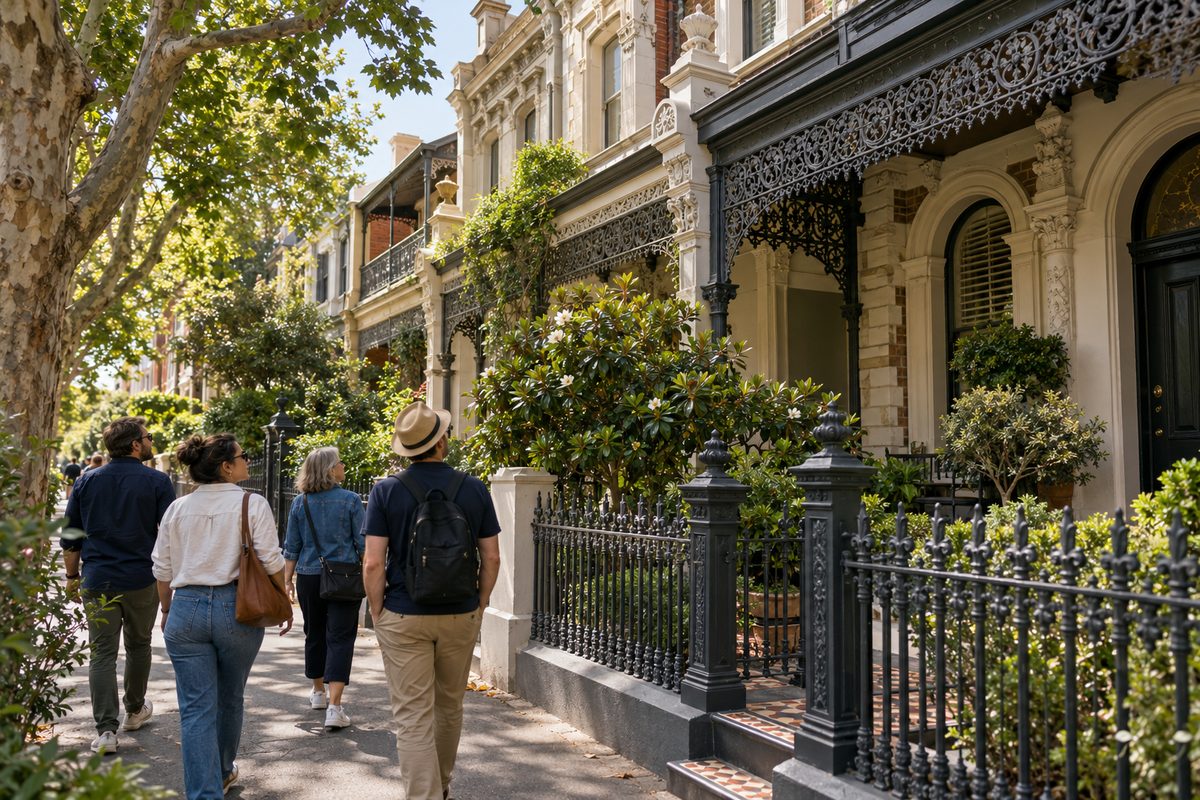
St Kilda Heritage Architecture Walk
The best St Kilda heritage architecture walk is a self-guided loop of about 4 km. It starts among the 1800s mansions on the hill and finishes at the seafront landmarks. Allow two to three hours. The order matters. If you start on the hill and finish at the bay, you see the suburb's buildings roughly in the order they were built. You begin with the Victorian mansions of the gold rush era. Then you pass Edwardian and interwar flats, and you end with post-war towers and rebuilt seaside icons. Read that way, St Kilda, Victoria tells its own history in brick and render.
This guide is from St Kilda Almanac. It sets out the route, how to tell each style apart and how to check which buildings are protected. For more local guides, visit the St Kilda Almanac home page.
Why walk the styles in date order?
Walking in date order turns a pleasant stroll into a story you can follow. St Kilda grew in clear waves, and each wave left its own type of building.
- 1850s to 1890s: Wealthy Melburnians built large villas on the high ground to catch the sea breeze. Most are Victorian architecture, and many are Italianate.
- 1900s to 1910s: Smaller houses and early flats filled the gaps. These are Edwardian architecture.
- 1920s to 1930s: St Kilda became Melbourne's flat capital. Builders used Spanish Mission and Moderne looks for blocks aimed at renters and holiday makers.
- 1950s and 1960s: High-rise Modern architecture arrived on the foreshore.
Many walkers start at the beach because that is where the tram drops them. They see the newest buildings first and the oldest last, and the story runs backwards. Start up the hill and the changes make sense as you go.
Where does the loop start and finish?
Start at the corner of Fitzroy Street and Grey Street. Finish at St Kilda Pier. Route 16 and route 96 trams both serve the area. Route 96 ends at Acland Street, close to the middle of the loop, so it works as a backup exit if you run short of time.
Stop 1: Grey Street and the hill (Victorian and Italianate)
Grey Street and the streets around it hold some of the oldest large houses in the suburb. Look for Italianate architecture. Its signs are easy to spot once you know them:
- Rendered walls, often painted cream or stone colours
- Paired brackets under deep eaves
- Arched windows, sometimes in pairs
- A tower or belvedere on the grandest examples
The Italianate style came from England, where it copied Italian country villas. Gold rush money made it the go-to look for Melbourne's rich in the 1860s and 1870s. Many of these mansions were later cut up into boarding houses and flats. Look at a big villa with a long row of letterboxes. That shows you how St Kilda changed from a suburb of private estates to one of rented rooms.
Stop 2: Acland Street and Linden
Walk to Linden at 26 Acland Street. It is an 1870s mansion that now houses Linden New Art, a public gallery. It is one of the few old villas you can usually step inside, so check its opening hours before you go. Look at how it sits back from the street behind a garden. That setback was normal for the era and is now rare on busy Acland Street.
Stop 3: Edwardian and interwar side streets
Between Acland Street and the Esplanade, look out for red brick houses with terracotta roof tiles and timber fretwork on the verandahs. That is Edwardian architecture, built roughly from 1901 to the First World War. In Australia it often goes by the name Federation style.
Many of these houses use the Australian version of Queen Anne. Guides and online sources often send people to Queen Anne style architecture in the United States, with its round towers and wraparound porches. Use that comparison with care. Australian Queen Anne grew from the same English roots, but it adapted to the climate. It has deeper verandahs, terracotta in place of painted shingles and fewer towers. If you expect an American painted lady, you will walk straight past the local versions.
In the same streets you will see interwar flat blocks with arched porches, rough rendered walls and barley twist columns. These are Spanish Mission flats. The style descends from Mission Revival architecture, which started in California around the 1890s and copied the old Spanish missions there. Hollywood films made it fashionable in the 1920s. St Kilda builders liked it because it looked sunny and holiday-like, which suited a seaside suburb full of renters.
Stop 4: Moderne flats near the Esplanade
Moderne architecture is the style most walkers miss, because it is plain at first glance. Look for these clues:
- Curved corners on balconies or stairwells
- Long horizontal bands of brick or render
- Steel-framed windows that wrap around a corner
- Port-hole windows and flat roofs hidden behind a parapet
Moderne, often called Streamline Moderne, borrowed the look of ocean liners and trains in the 1930s. A seaside flat block that looked like a ship made sense to buyers. St Kilda has a large stock of 1930s flats, so once you can spot the curved corners, you will see them on almost every block near the water.
Stop 5: The Esplanade, Luna Park and the Palais
On the Esplanade, the Esplanade Hotel dates from the 1870s and keeps its Victorian front. Further south, Luna Park opened in 1912 with its famous Mr Moon face. The Palais Theatre next door opened in 1927. Both are well-known heritage places, and the Palais is one of Australia's largest seated theatres. Look up at the Palais roofline. Its scale shows how big the crowds were that came to St Kilda for entertainment between the wars.
Stop 6: Edgewater Towers on Marine Parade
Edgewater Towers stands at 12 Marine Parade. It was finished in 1961 and was Melbourne's first privately built high-rise apartment block. It rises 13 storeys above the foreshore. The architect was Mordechai Benshemesh.
Most heritage walks skip post-war buildings. That is a mistake. Edgewater Towers is pure Modern architecture: a slim slab, ribbons of glass and no decoration at all. It marks the point where St Kilda stopped building houses and low flats on the foreshore and started building upward. It is a private residential building, so view it from the street and do not try to enter.
Stop 7: St Kilda Sea Baths and St Kilda Pier
Walk north along Jacka Boulevard to the St Kilda Sea Baths. Sea bathing pavilions have stood here since the 1800s. The domed 1930s building was redeveloped in the early 2000s. Its Moorish style front, with domes and arches, is the image most people know. Treat it as a heritage-inspired rebuild, not an untouched original.
Finish at St Kilda Pier. The pier dates back to the 1850s. Its kiosk started life in 1904, burned down in 2003 and was rebuilt to match the original. In recent years the pier itself has been rebuilt. Check Parks Victoria for current access before you go. If you want to stay for the little penguins at the breakwater, viewing now runs in free ticketed sessions. Book through the official operator before you plan your evening around it.
How do you check whether a building is protected?
Use two free online sources. They cover different levels of protection.
- The Victorian Heritage Register lists places of significance to the whole state. Heritage Victoria runs it under the Heritage Act 2017. Changes to these places need a permit from Heritage Victoria, and this can include inside the building.
- The Heritage Overlay is a local control in the planning scheme. The City of Port Phillip applies it to individual buildings and to whole streets known as heritage precincts. Most of the time, it controls demolition and changes to the outside of a building.
You can search both through the Victorian Heritage Database. Search a street address and it will show whether a place is on the state register, covered by a local overlay or both. Each entry usually comes with a statement of significance. That is a short note on why the place matters. Read the entry for the street you are standing on and the walk gets far more interesting.
Here is a common mix-up. People often assume that an old building without a state listing has no protection. In St Kilda, much of the hill and many streets near the foreshore sit inside precinct-wide Heritage Overlay areas. An ordinary-looking Edwardian house can be protected because it adds to the character of the whole street. Check the City of Port Phillip planning scheme maps before you assume anything.
What do most walkers get wrong?
They only look at street level. Shopfronts on Acland Street and Fitzroy Street have often been modernised. The original Victorian or Edwardian upper floors survive above them. Look up past the awnings and you will often find dates, names and parapets that the ground floor hides.
They mix up Italianate and Moderne because both are rendered. Rendered walls tell you very little on their own. Check the corners instead. Italianate corners are square and trimmed with heavy mouldings. Moderne corners are curved and plain.
They skip the 1930s and 1960s. St Kilda's flats are what make it different from other Melbourne suburbs. Many suburbs have Victorian villas. Few have this many interwar flats and early high-rises in one walkable area.
They treat rebuilt landmarks as originals. The pier kiosk and the Sea Baths both carry heritage character, but large parts are recent rebuilds. Knowing this helps you read the place honestly.
How long should you allow, and when should you go?
Allow two to three hours for the full loop at a slow pace with stops. The walking alone takes about an hour. The hill section has gentle slopes. The foreshore is flat and sealed, so it suits prams and most mobility needs.
Go on a weekday morning if you want to take photos. The Esplanade and Acland Street get crowded on weekend afternoons, and parked cars block the lower part of many facades. Overcast days are good for architecture photos because shadows are softer and render detail shows better.
Hypothetical example: Two friends catch the route 16 tram to Fitzroy Street at 9 am on a Tuesday. They walk the hill, stop at Linden when it opens and reach Edgewater Towers before lunch. They eat on Acland Street and finish at the pier by early afternoon. They have seen about 100 years of building styles without rushing.
How does this walk fit with other St Kilda walks?
This walk looks at buildings. The foreshore walks along Port Phillip look at the bay, the beaches and the parks. Both start in the same area, so you can join them. Finish this loop at the pier, then head south along the foreshore toward Elwood if you still have energy. Or catch a tram from Fitzroy Street back to the city. Find route guides for the foreshore on the St Kilda Almanac home page.
Your plan for the walk
The single most useful thing you can do: walk the suburb in date order, from the hill down to the bay, and you will read St Kilda's history in its buildings.
- Catch a route 16 or route 96 tram and start at Fitzroy Street and Grey Street.
- Before you leave, look up two or three addresses in the Victorian Heritage Database and read their statements of significance.
- Check Linden New Art's opening hours if you want to go inside an 1870s mansion.
- Learn four clues: brackets and arches for Italianate, red brick and terracotta for Edwardian, arches and rough render for Spanish Mission, curved corners for Moderne.
- Look up above shop awnings on Acland Street and Fitzroy Street.
- View Edgewater Towers from Marine Parade and respect residents' privacy.
- Check Parks Victoria for pier access, and book a free penguin session with the official operator if you plan to stay until dusk.