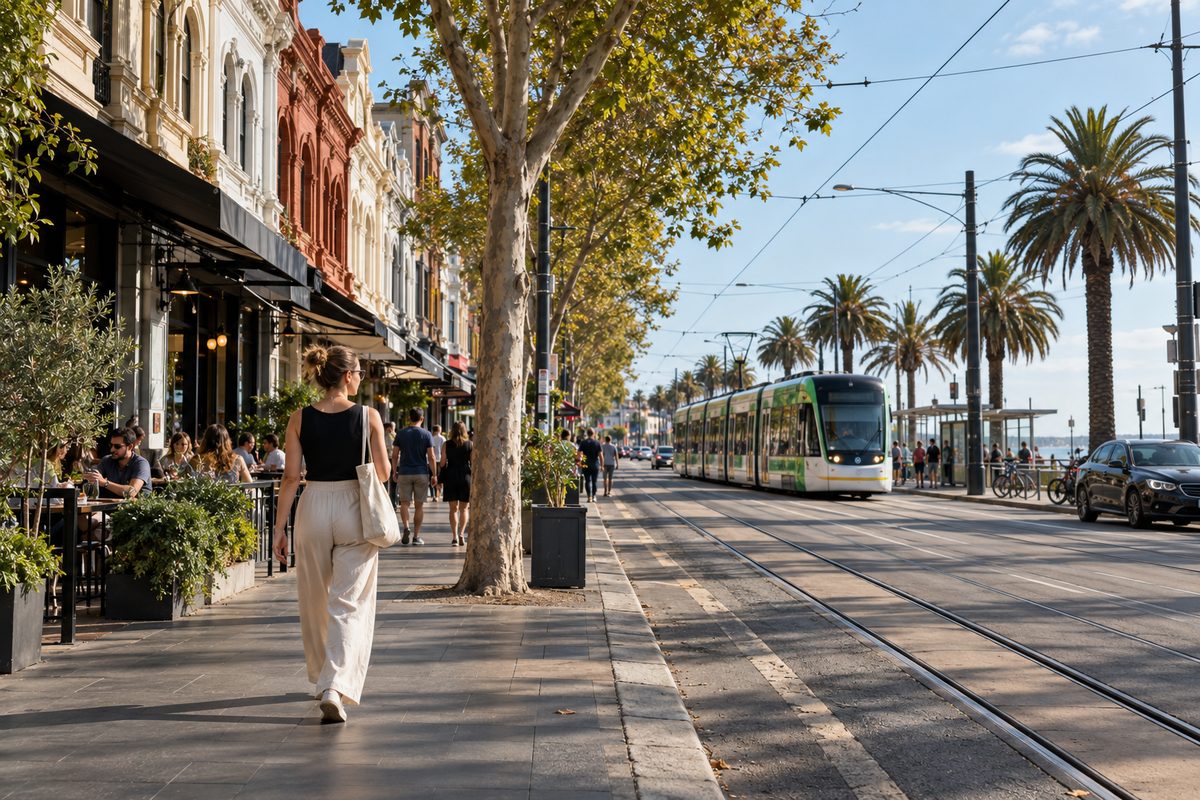
St Kilda Fitzroy Street Neighbourhood Walk
The best Fitzroy Street walk starts near St Kilda Junction, follows the street downhill to the beach and takes about 20 to 30 minutes at an easy pace, or an hour or two with stops. The street is short at roughly one kilometre. Read it as a slope that ends at the water. Each block tells you about a different period of St Kilda, Victoria, from the grand seaside resort era to the tidy cafe strip of today. This guide from St Kilda Almanac sets out the route, the stops worth slowing down for and the mistakes that make the walk feel flat.
Which Fitzroy Street are we talking about?
This walk covers Fitzroy Street, Melbourne, in St Kilda. It is a different place from Fitzroy, Victoria, the inner-north suburb known for Brunswick Street and Gertrude Street. Visitors mix them up often, and map apps sometimes send people to the wrong side of the city.
A quick check fixes it. The St Kilda street runs from the St Kilda Road end near St Kilda Junction down to the foreshore at Port Phillip. If your map shows the bay at the end of the street, you are in the right place.
Both streets carry the FitzRoy name, a common Victorian-era naming choice, but they share nothing else. The St Kilda one is a beach approach. The northside suburb has no beach at all.
Why walk it downhill instead of up?
Walk it towards the water. The street falls gently from the inland end to the bay, so you get an easy grade and a view that opens up as you go. The bay appears between the buildings in the last few blocks, and that reveal is the payoff of the whole walk.
Walking uphill does the opposite. You finish at a busy road junction with the sea behind you. Here is a hypothetical example: a visitor who starts at the beach and heads up Fitzroy Street usually turns around halfway because the inland end feels like the edge of the city rather than a destination. Start inland and the walk builds instead of fading.
There is a practical reason too. The beach end connects to more places to go next. From there you can reach St Kilda Pier, Catani Gardens, the Esplanade and Acland Street on foot within minutes.
How do you get to the start?
Trams in Melbourne make this the easiest walk in the area to reach without a car. Several routes come down St Kilda Road and turn into Fitzroy Street, and others run along the street itself. Route numbers and timetables change, so check Public Transport Victoria (PTV) on the day before you set out.
The most interesting way in is via the old St Kilda light rail station near the top of Fitzroy Street. This was the end of the St Kilda railway line, one of Melbourne's earliest suburban train lines, which opened in 1857. The line closed as heavy rail in 1987 and was turned into light rail, so trams now run on the old train corridor. The heritage station building still stands near the stop.
Spend two minutes looking at it before you start walking. It explains why Fitzroy Street became busy in the first place. Trains brought day-trippers from the city to the beach, and the street was their path from the platform to the sand.
If you come by car, parking near the beach end is metered and busy on warm weekends. Check City of Port Phillip signs for time limits. A simple fix is to park further inland, walk down and catch a tram back up.
What will you see from top to bottom?
Break the walk into three short stretches. Each one feels different, and knowing that ahead of time stops you from rushing past the parts that matter.
The top end: junction, trees and old money
Near St Kilda Junction, Fitzroy Street feels like a wide boulevard. You will notice the wide road, tram tracks down the middle and big street trees. Look up at the older buildings. Many date from the late 1800s and early 1900s, when St Kilda was a fashionable place for wealthy Melburnians to live and holiday.
Albert Park and its lake sit close by on the city side. If you have extra time, a loop around the lake before the walk adds green space and a longer warm-up.
The middle: the dining strip
The middle blocks hold most of the cafes, bars and restaurants. Outdoor tables spill onto wide footpaths. This is the busiest part of the walk at lunch and in the evening.
Look out for the George, a large historic hotel building near Grey Street. It began life as a hotel serving visitors from the nearby train station and has been reused in different ways since. Buildings like this show how the street kept its old shell while the uses inside kept changing.
Operators change often on this strip. Venues open and close faster than guides can track, so check current opening hours before planning a meal around a specific place.
The bottom end: the bay comes into view
As you near the Esplanade, the street widens out and the bay fills the gaps. You will pass the Prince, a long-running hotel and music venue near the foot of the street. Then you reach the foreshore, with palm trees, grass and the water of Port Phillip straight ahead.
Cross carefully here. The roads at the bottom are wide and carry fast traffic plus trams. Use the signals.
What history explains the street you are walking?
Fitzroy Street makes more sense once you know it went through a rough patch and came back. Most short guides skip this, yet it is the reason the street looks the way it does today.
In the second half of the 1800s, St Kilda grew as a seaside resort. The railway, the baths, the pier and the grand hotels turned it into the place Melbourne went to relax by the sea. Fitzroy Street was the main route from the station to the beach.
Through the middle of the 1900s, wealthy residents moved to newer suburbs. Big houses became boarding houses and flats. By the 1970s and 1980s, parts of Fitzroy Street were known for drugs, street sex work and run-down buildings. Locals from that time often describe it as rough after dark.
Urban renewal changed the street from the 1990s onwards. Rents and property values rose, and new restaurants and apartments arrived. The City of Port Phillip invested in streetscape works such as wider footpaths, new paving and seating to make the street easier to walk and to sit in.
The result is mixed, and that is worth seeing for yourself. Some longtime residents say the street lost its edge and some character. Others say it is safer and friendlier than it has been in decades. In recent years, empty shopfronts have also been a recurring local talking point. As you walk, look for the gaps between busy venues. They tell you the renewal story is still going.
Is Fitzroy Street really a strip?
Yes, in the Melbourne sense of a strip: a single street lined with places to eat and drink. People sometimes describe it with bigger comparisons, and one that comes up is the Las Vegas Strip. The comparison does not hold. Fitzroy Street has no casinos, no giant resorts and nothing on that scale.
A better way to think of it is as a front door to the beach. It is short, walkable and built around trams. You can cover it on foot in well under an hour, and almost everything sits within a minute of a tram stop.
This matters for how you plan. Do not expect a long run of entertainment that keeps you busy all night. Expect a pleasant walk with good stopping points, then a choice of where to go once you reach the water.
Where should the walk finish?
Pick your finish based on what you want from the rest of the day. The bottom of Fitzroy Street works as a hub, and each option is a short walk away.
- For the water: Head right along the foreshore to St Kilda Pier. The walk out to the end is a natural extension of Fitzroy Street. Little penguin viewing at the breakwater runs through free ticketed sessions, so book through the official operator before you go rather than turning up at dusk and hoping.
- For food and cake shops: Turn left and follow the Esplanade, then cut up to Acland Street. Acland Street is the other main strip in St Kilda, known for its old cake shop windows and busy weekend crowds.
- For a quiet sit: Catani Gardens sits right by the foot of the street, with lawns and palms facing the bay. It is a good place to rest before the trip home.
- For the Sunday market: The Esplanade hosts an arts and crafts market on Sundays. Check current times with the organisers before planning around it.
If you plan to take children, note that St Kilda Adventure Playground is temporarily closed for upgrades as of October 2026. Check its current status with the City of Port Phillip before promising it as part of the day.
For more ideas on what to pair with this walk, browse the guides on the St Kilda Almanac home page.
When is the best time to walk it?
Late afternoon on a weekday gives the best mix. The light is warm, the footpath tables are filling but not packed, and you can reach the foreshore in time for sunset over the bay. The sun sets over Port Phillip on this side of Melbourne, which makes the beach end of the walk the right place to be at dusk.
Weekend mornings suit people who want quiet. Many cafes open early, and the street is calm before the beach crowds arrive.
Hot summer weekends are the hardest time. Trams are full, parking fills early and the foreshore gets crowded. If you go then, start earlier and take water, because the street has limited shade in the lower blocks.
Late nights bring a different feel. The bars stay busy, and the bottom end around the hotels gets loud. If you want a calm walk, avoid Friday and Saturday nights.
What do people get wrong about this walk?
The most common mistake is treating Fitzroy Street as a quick shortcut to the beach. People ride the tram straight past it, hop off at the bottom and miss the history at the top. The whole point of the walk is the change you see from one end to the other.
The second mistake is confusing it with Fitzroy, Victoria. As covered above, the two are on opposite sides of the city. Double-check your map.
The third mistake is skipping the St Kilda light rail station. It takes only a few minutes to see and explains the whole reason the street exists.
The last mistake is ignoring St Kilda Road. It is one of Melbourne's grand boulevards and connects the city to St Kilda Junction. If you have time, ride a tram down St Kilda Road first. You then arrive at Fitzroy Street with a sense of how the city once flowed down to the sea.
A simple route to follow
- Take a tram to the St Kilda light rail stop near the top of Fitzroy Street, or come down St Kilda Road from the city.
- Look at the heritage station building on the old St Kilda railway line.
- Walk downhill along Fitzroy Street towards the bay, keeping to the wide footpaths.
- Stop in the middle blocks for a coffee or a meal, checking opening hours first.
- Pass the old hotels near the bottom and cross carefully at the Esplanade.
- Choose your finish: St Kilda Pier, Acland Street or Catani Gardens.
- Catch a tram home from the beach end.
Your next step
Pick a weekday afternoon this week, check PTV for the tram to the St Kilda light rail stop, and plan to reach the bottom of Fitzroy Street about 30 minutes before sunset. If you want to see the penguins afterwards, book a free session with the official operator before you leave home. That one bit of planning turns a short street into a full evening by the bay.